
Corinex dynamically manages available power at the point of connection, helping CPOs maximise charger utilisation within existing network limits. BPL connectivity and local control provide the infrastructure to coordinate charging in real time without relying on a separate cellular connection at every charger.








As charging networks scale, connectivity and local power management become harder to solve site by site. Cellular coverage can be weak in underground, indoor, rural and remote locations. Large estates also create recurring SIM costs, more endpoints to manage and greater dependence on public mobile networks. Corinex turns the electrical infrastructure already serving the chargers into the local communications network—while supporting OCPP-based operation, edge control and controlled upstream connectivity.

Reach chargers where direct LTE can be weak, inconsistent or unavailable.

Reduce the number of independent cellular endpoints, subscriptions and SIMs across multi-charger deployments.

Keep load-balancing and selected charger decisions close to the site instead of sending every exchange across the WAN.

Monitor BPL topology, signal quality, device status and communication health from the managed network.

Scale charging sites without treating every charger as a separate telecom endpoint. Corinex combines local connectivity with edge control so CPOs can simplify communications and manage charging within site limits.

Give orchestration platforms a more dependable path to the physical assets they manage. Local edge intelligence can support faster, more granular control without requiring every operational decision to travel to a central platform.
At the charger, a Corinex BPL endpoint connects to the charge point or site controller. Approved IP traffic is carried over the existing electrical network to a BPL headend, where it can be forwarded to the operator's OCPP or charging-management environment.
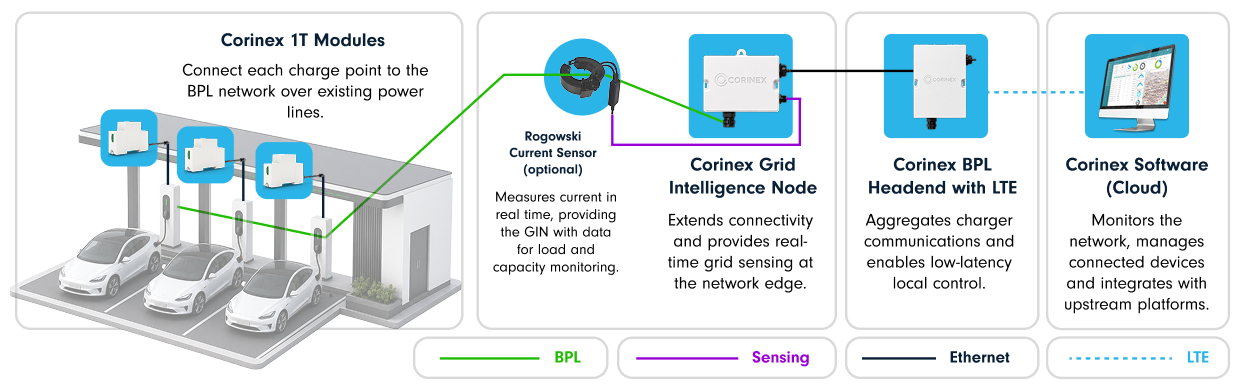
Corinex enables local charger control and load balancing at the site, so operations do not depend entirely on a continuous WAN or LTE connection. If upstream connectivity is lost, predefined fail-safe logic can keep charging operating within safe local limits until communication is restored.
Corinex can also operate as a protocol-transparent BPL network. OCPP and other approved IP traffic pass unchanged to the upstream server, while BPL management remains logically separate.
Use existing power lines for connectivity and reduce new communications cabling, per-charger LTE equipment, SIMs and recurring subscriptions across larger deployments.
Connect chargers over the same electrical infrastructure that supplies power, including locations where cellular coverage may be weak, inconsistent or unavailable.
Handle selected charger control, load balancing and fail-safe operation locally, reducing dependence on continuous WAN connectivity and centralised processing.
Protect charging infrastructure through authenticated device access, encrypted communications and logical separation between application traffic and BPL network management.
BPL is particularly relevant where direct cellular coverage is unreliable or operationally inefficient. That can include underground car parks, shielded electrical rooms, dense urban sites, rural or remote charging locations, and larger estates where managing a separate mobile connection at every charger does not scale cleanly.
Corinex uses a layered security model. OCPP application security remains protected by the charger and its OCPP endpoint, while the managed BPL domain protects network participation, device access and infrastructure management.
Only authorised devices and management systems participate in the managed BPL domain.
Application traffic and privileged BPL management remain logically separated.
Secure administrative access, credential lifecycle controls, logging and protected update procedures support operations.
Whether you operate charge points or aggregate flexible charging assets, Corinex can help build a more dependable communications and control layer around the infrastructure already in place.
Common questions about deploying Broadband over Powerline (BPL) for EV charging networks.
Corinex BPL transmits data directly over existing electrical power lines, eliminating the need for mobile cellular signals in underground, shielded, or remote locations.
Corinex supports standard protocols including OCPP 1.6, OCPP 2.0.1, and ISO 15118. It can operate as a protocol-transparent network or a local edge controller.
GridFlex continuously monitors transformer loading and feeder voltage at the grid edge, delivering sub-100 ms local setpoint adjustments to balance demand within agreed G100 limits.
No. Corinex BPL operates directly over existing low-voltage and medium-voltage power cables, significantly reducing CAPEX and installation complexity.
Corinex applies a layered security model featuring PKI certificate lifecycle management, DTLS encrypted sessions, and logically isolated BPL management paths.